
Deepfake fraud · November 2026
Your CEO just called. It wasn’t your CEO.
In early November 2026, the US Department of Justice charged a ring that cloned executives and stole $129 million. Your security awareness training would not have stopped it. Here is what does.
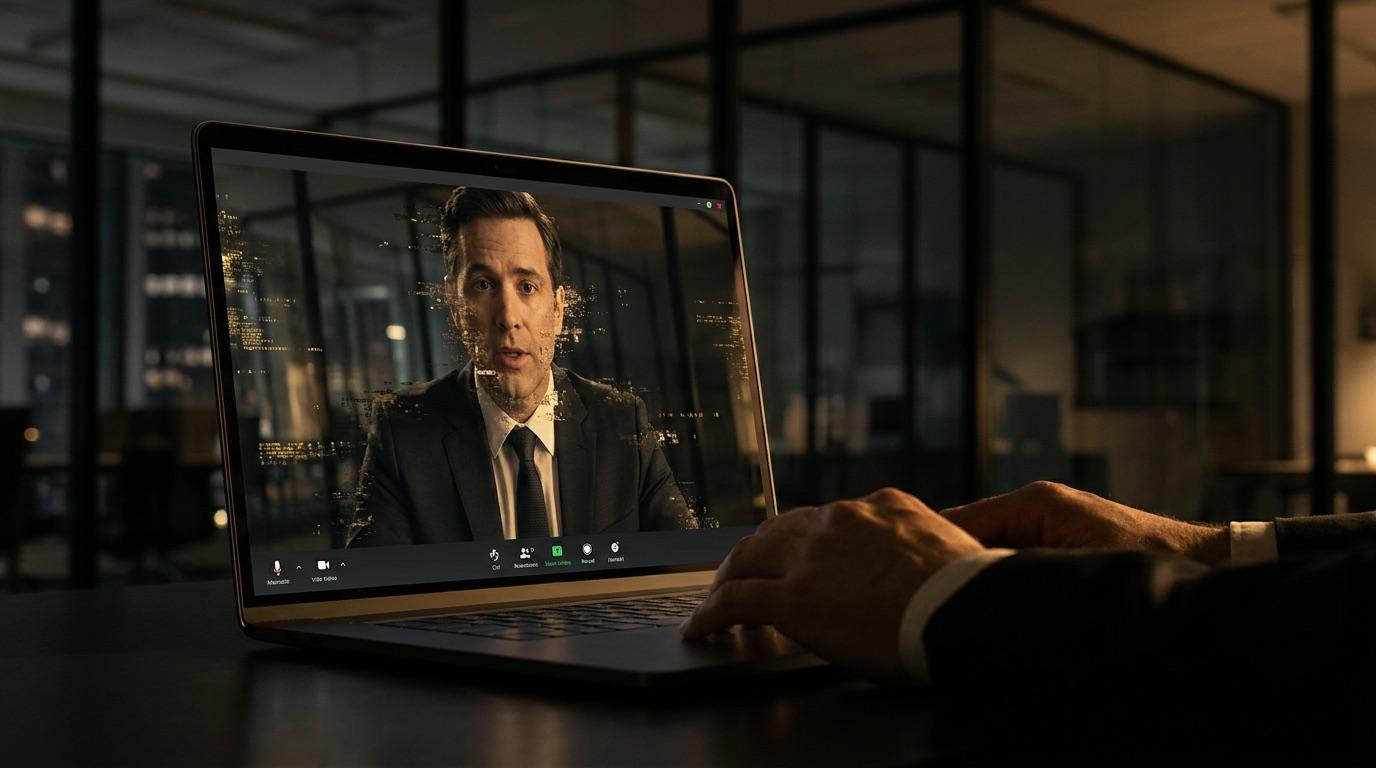
In early November 2026, three men were charged in a New York federal court with a crime that barely existed a few years ago. Using artificial intelligence to clone the voices and faces of chief executives, they called the people who actually move the money, the staff in accounting, and talked them into sending it away. Across a string of companies, the total was $129 million.
The method is worth sitting with, because it is almost boring in its simplicity. No breach. No malware. No clever exploit. A caller who sounded exactly like the CEO got an employee on the line. The callers posed as the CEO and as lawyers from large international law firms. The requests were urgent and confidential. The tools were the kind anyone can buy off the shelf.
Among the victims were two US hospital systems and a British fintech. Real finance teams, at real companies, who had almost certainly completed their annual security awareness training.
It did not arrive as a suspicious email. It arrived as a familiar face, a familiar voice, and a reason to act now.
Trained, and still not ready
This is the part that should trouble anyone responsible for security. Every one of those employees could probably spot a phishing email. They had been taught the red flags. None of it helped, because the attack did not come through the channel the training prepares people for. It came through the phone, wearing the face of someone they trust.
Security awareness training measures one thing well: whether people finished it. Ninety-four percent trained. Green across the board. That is the number every victim’s dashboard showed, right up until the wire went out. Completion is not readiness. Knowing in the abstract that deepfakes exist does nothing in the ninety seconds an accounts-payable clerk is on a call with a perfect clone of their CEO and a convincing lawyer, being told to move the money, quietly, now.
How it happens
Anatomy of the call
There is no hacking in this chain. Every step is a human being doing their job under pressure, inside a story that looks exactly right.
- 01
The set-up
An email or invite books a quick call with the boss.
- 02
The face
A video call. The CEO, cloned and on screen.
Not real - 03
The hand-off
Passed to a “lawyer” from a large international law firm.
Not real - 04
The pressure
Urgent. Confidential. Keep it between us.
- 05
The wire
The money leaves in minutes. Nobody is coming to get it back.
You just do not hear about it
This case made headlines only because it ended in an indictment. Most never do. A company that wires seven figures to a cloned voice does not issue a press release. It absorbs the loss, tightens a policy, and never speaks of it again. So the rhythm you perceive, one dramatic story every few months, bears no relation to the real rate.
Voice fraud in banking rose roughly 30 percent in 2025. Nearly a quarter of financial-services firms say a deepfake has already cost them more than a million dollars. Those are not the headlines. They are the quiet ones, and your own people are somewhere in that number whether or not you have heard about it yet.
Awareness isn’t behaviour.
What actually works is rehearsal
Pilots do not become “aware” of engine failures. They rehearse them in a simulator until the correct response is muscle memory. We accept that standard for every high-stakes job, except, somehow, the one where an employee can move eight figures out of the building in a single phone call.
The only thing that reliably changes behaviour under a live attack is having been through it before. Your people should meet their first deepfake CEO call in a drill you sent them, not in the real one. Then you learn who hangs up, who reports it, and who would have sent the money, while the cost of being wrong is a coaching conversation instead of a loss.

That is the whole idea behind Vigil. We run safe, lifelike deepfake voice and video drills, always with the consent of the person whose likeness is used, alongside modern phishing. For every person, you get a human-risk score instead of a completion certificate. You stop measuring attendance, and start measuring readiness.
Reading about deepfakes changes nothing. Rehearsing one does. Vigil clones a consented executive and runs the live call against your team, so your people meet the attack before an attacker makes it.
Vigil
Would your team hang up?
Take the deepfake call yourself, before you ask it of your people.
Take the callThe way to know is to put your own people through it. We will run a deepfake drill, built from a consented voice, safely against a team you choose. Request a deepfake drill
Rehearse. Learn. Prove.
Sources
- Three men charged in $129M AI CEO-impersonation scheme. NBC News, November 2026.
- Voice fraud in banking up roughly 30% in 2025. “The voice fraud threat to banking,” ABA Banking Journal, August 2026.
- Nearly a quarter of financial firms report deepfake losses over $1M. Reality Defender / Regula, 2025.
Vigil is the human risk and compliance platform built for the AI attack era. Written by the Vigil team.